The Magnet Factory Is American. The Chemistry Is Not.
The West is building factories for the magnets inside fighter jets, electric vehicles and wind turbines. China still dominates the separation of dysprosium and terbium, the metals added so some of the strongest magnets keep working under heat. Two approaching deadlines will test whether the West has built a supply chain of its own, or only the final stage of a dependency.
The clearest recent sign of that gap came in March 2026, when Lynas, an Australian rare-earth producer, and the U.S. government changed course on a planned heavy-rare-earth separation plant in Seadrift, Texas.
In its place, the parties signed a binding letter of intent for a four-year supply arrangement: about US$96 million previously allocated to construction would instead buy separated light- and heavy-rare-earth oxides from Lynas's Malaysian operations, for U.S. national-security and supply-chain needs. The company cited significant uncertainty over whether the Texas plant would proceed.
The agreement buys supply. It does not build the missing U.S. step.
That distinction captures the central problem in the effort to loosen China's hold on rare-earth magnets. Opening a factory is not the same as building an independent supply chain. A manufacturer can install equipment and begin producing magnets while still relying on foreign processing, controlled exports or lengthy customer approvals. Two dates now test that distinction: 10 November 2026, when China's pause on its broader export controls ends, and 1 January 2027, when a U.S. defence sourcing rule expands.
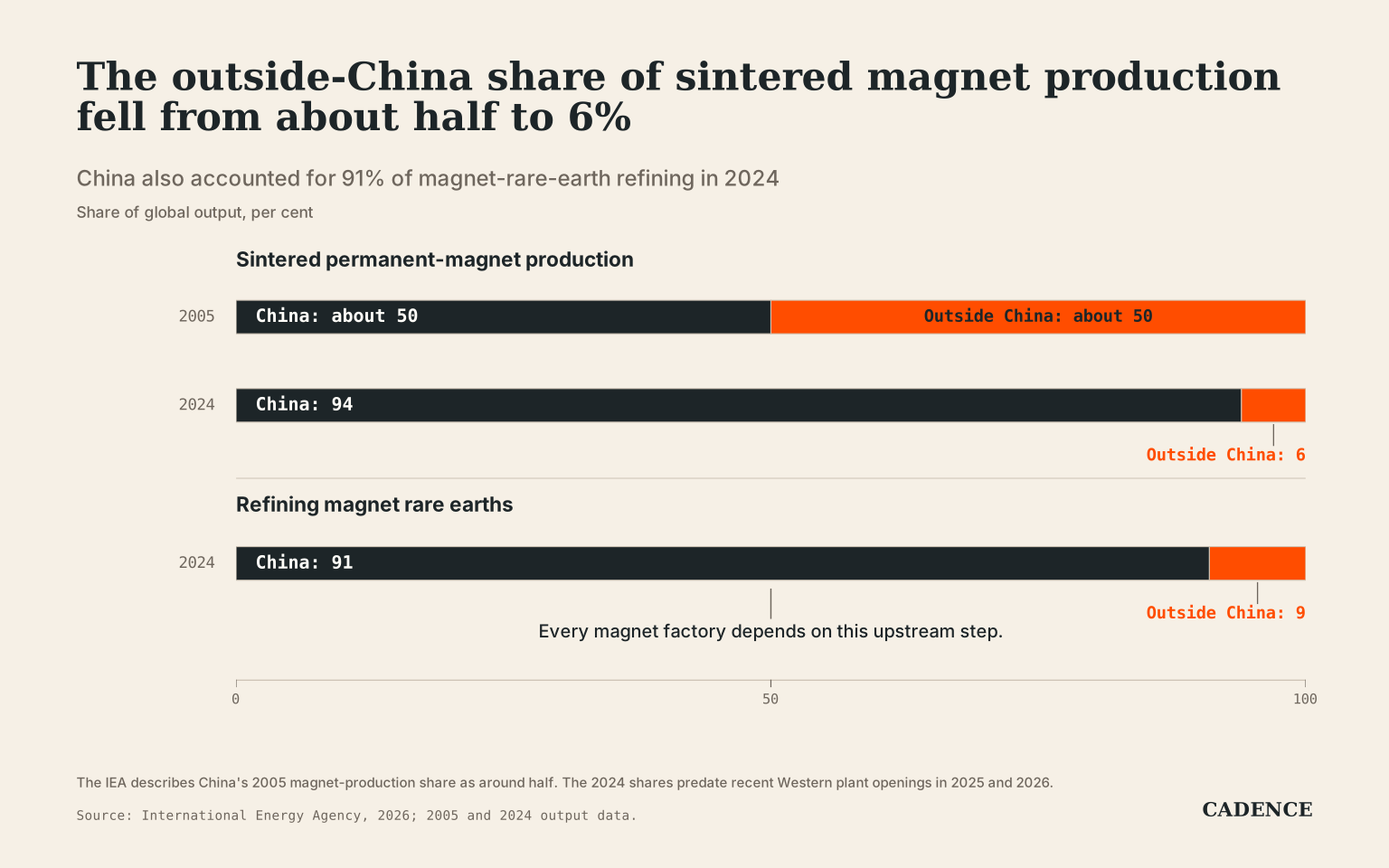
China accounted for about 91 per cent of global separation and refining for magnet rare earths in 2024, according to the International Energy Agency, and an even larger share, about 94 per cent, of sintered permanent-magnet production, up from about half of magnet production in 2005.
The concentration matters most for dysprosium and terbium, the heavy rare earths added to some neodymium-iron-boron magnets so they resist demagnetization at high temperatures, in electric motors, wind turbines, aerospace equipment and defence systems.
One magnet held up F-35 deliveries
In September 2022, the Pentagon stopped taking delivery of completed F-35 aircraft after a samarium-cobalt magnet inside a turbomachine made by Honeywell, an aerospace supplier, was found to contain an alloy melted in China. The turbomachine provides power to the aircraft's engine-mounted starter/generator. The Pentagon said the material posed no safety-of-flight or information-security risk. About a month later, deliveries resumed after William LaPlante, the Pentagon's acquisition chief, signed a national-security waiver covering about 126 affected aircraft.
The material in that case was samarium-cobalt; the present bottleneck involves dysprosium and terbium. The lesson is the same: a part can exist and still be unusable because its origin or qualification fails the rule. A defence buyer then faces a waiver, a redesign, more testing or requalification, or a delay.
Where usable supply is decided
Five hand-offs stand between ore in the ground and an approved part. Each must succeed before the next one matters.
- Miners turn rare-earth-bearing ore into mixed material.
- Processors separate individual elements. China dominates this step; Lynas's output of about 8 tonnes of separated dysprosium and terbium oxides in early 2026 is the working exception.
- Metal and alloy makers convert oxides into the inputs magnets are made from.
- Manufacturers turn those inputs into finished magnets.
- Customers test, qualify and approve magnets for specific motors, aircraft and other systems.
Chinese export licensing, administered by the commerce ministry MOFCOM, is not a manufacturing stage: it constrains the movement of controlled material and magnets across this chain. The November date decides how widely that licensing net is cast; the January rule acts separately on defence buyers at stage 5.
The visible factory sits at stage 4. The strategic leverage sits further upstream: before those metals can enter a magnet, processors must separate them to the required purity, and metal makers must convert them into usable alloys.
Factories are moving. Approval is slower.
MP Materials, a U.S. rare-earth producer, said it began manufacturing magnets at its Fort Worth facility in December 2025. In the first quarter of 2026, its Magnetics business reported US$21.1 million in quarterly revenue, all of it from magnetic precursor products, including metal sold under an agreement with General Motors, the automaker, rather than finished magnets. The company said it expected to begin sales of finished magnets to GM during 2026. MP currently supplies GM with precursor metal; the commercial decision is whether GM accepts the finished magnet for a particular motor.
USA Rare Earth, a U.S. magnet developer, commissioned the first phase of its Stillwater, Oklahoma, line in the first quarter of 2026. In its May filing it said it had not yet begun commercial magnet production or sales at the plant, and that commissioning should allow it to begin filling orders during the second quarter. That was a forecast. Filings through 17 July 2026 do not confirm it was met.
Neo Performance Materials, a Canadian materials company, shipped its first sample magnets from Estonia in April 2025. By February 2026 the facility had produced its one-millionth magnet, and by May the company was shipping qualification magnets for several awarded automotive programmes, with some expected to enter commercial production during 2026. The first-half target was the production-part approval process, a formal customer-qualification step; filings through 17 July 2026 do not confirm completion or recurring commercial volume.
Lynas's Malaysian operations produced about 8 tonnes of separated dysprosium and terbium oxides in the quarter ending March 2026. That is working commercial output outside China. It is not evidence of capacity comparable with China's, and the available figures do not support a valid ratio between the two.
The projects are real. A plant opening, by itself, says little about the material actually available to customers.
Commissioned equipment is not commercial production. Qualification shipments are not approved parts. Production-part approval is not full customer approval, and approval is not repeatable supply at scale. A resilient chain requires all of them, and the milestones so far prove the industrial response is real. They do not yet prove that a customer can buy the right magnet, in the right quantity, with the right origin, and use it without an exception.
The West built the plant before it replaced the chemistry.
Beijing decides first. Buyers pay later.
China's April 2025 controls on seven medium and heavy rare-earth elements, including dysprosium and terbium, remain in force. Exporters of covered products need licences from Chinese authorities; the controls are a licensing regime, not a blanket ban, and Chinese officials have said eligible civilian applications may be approved.
The broader October 2025 package widened the regime to five additional elements, processing equipment and technology, and, under specified conditions, certain foreign-made items containing Chinese-origin inputs or made with Chinese technology. Its suspension ends on 10 November 2026. Unless the pause is extended, the package is set to resume.
From 1 January 2027, U.S. defence acquisition rules expand to the whole supply chain for samarium-cobalt and neodymium-iron-boron magnets, from mining or feedstock through the finished magnet, when a covered production stage occurred in China or another covered country. The rule acts on defence buyers and their purchasing decisions, not on Chinese authorities.
Under the U.S. rule, an authorized official can permit an acquisition when compliant material cannot be obtained in the needed quality, quantity, form and time at a reasonable price. That permits a purchase; it does not create replacement supply. The two deadlines therefore test different links: Beijing decides access upstream; Washington tightens buyer-side sourcing downstream.
Both deadlines matter less if qualified alternatives arrive first. So far, public disclosures show progress but no date by which qualified non-Chinese supply exists at scale. And because approval is customer-specific, that date may never arrive as a single day for the whole industry; it will arrive customer by customer.
The policy dates are fixed. The supply milestones are not.
Two fixed dates. No verified qualified-supply date.
The important gap is not the 52 days between 10 November and 1 January. It is the distance between fixed policy dates and unfinished customer approval. Observed industrial starts and company targets carry different kinds of certainty. The evidence still lacks the one date a buyer needs: qualified non-Chinese supply at scale.
The first cost is time and proof
An automotive company such as General Motors can face a commercial constraint: a factory running while it still needs more testing, another source or more time before a particular magnet is accepted for a particular motor. Ordinary commercial purchases are not directly governed by the U.S. defence rule, but industrial buyers still feel supply, qualification and bargaining-power pressure.
Defence buyers have a shorter menu: a compliant source, an exception, a redesign, more testing or requalification, or a delay. The F-35 case showed completed hardware waiting while the buyer secured one. China's leverage rests not only on tonnes of material, but on the time and proof required to turn another tonne into an accepted part.
Who gains leverage, who bears the pressure when China decides
An extension eases timing. A resumption widens the licensing perimeter and forces choices. Neither, by itself, creates qualified non-Chinese supply.
| Actor | If China extends the pause | If the broader controls resume |
|---|---|---|
| Chinese licensing authorities | Leverage retained. China can ease flows without giving up the permission gate. | Leverage widens. More material, equipment and technology depend on licence scope and timing. |
| Non-Chinese separators and alloy makers | Urgency eases; scarcity does not. More time supports scaling and qualification, but available volume stays limited. | Allocation power rises. Scarce qualified tonnes decide which customers and programmes move first. |
| Western magnet manufacturers | More runway, same two gates. Feedstock and customer approval still decide usable output. | The middle gets squeezed. Input timing turns less predictable while finished magnets still need customer approval. |
| Industrial buyers | The hard choice is deferred. Buyers gain time to test alternatives without changing production schedules. | The buyer must choose. Draw inventory, secure licensed supply, qualify another source, redesign, or delay. |
| U.S. defence buyers and prime contractors | A closing window. Alternatives can be qualified before the sourcing rule expands on 1 January 2027. | Two rules collide. Chinese permission overlaps with U.S. sourcing restrictions; the options narrow to an exception, requalification, redesign or delay. |
These effects are directional and conditional. No single data series can translate them into a named company’s cost, a fixed delay or proof of why a shipment moved.
China can loosen without letting go
The strongest countercase is managed access. China could extend the pause or approve licences more broadly; non-Chinese suppliers could qualify faster than disclosures suggest, and Neo has commissioned a small dysprosium and terbium separation line in Estonia, while engineering could reduce the heavy-rare-earth content of some grades. Even then, aggregate exports could recover while strategic U.S. users stayed constrained by licence conditions. That case changes timing before it changes dependence.
The strategic result
The strategic result so far is narrower than the construction boom suggests. The benign outcome is managed access: licences broaden and flows recover while alternative supply scales, and the pressure becomes easier to live with.
The structural bar is higher: separation, metal and alloy production, and magnets that customers approve, delivered repeatedly at disclosed volumes, outside Chinese permission.
The highest-risk outcome is the quiet one: Western factories running on Chinese-licensed material while approval gaps persist, public funds financing access while replacement capacity develops more slowly. The West would then be paying to diversify while bargaining power remains upstream. These outcomes will not announce themselves. Cadence keeps watch in What We Track.
Three ways China's grip loosens
Each cuts China's leverage one level deeper, and each would move our judgment.
| What happens | What it would show | Effect on our judgment |
|---|---|---|
| China extends the pause and durable licences broaden to strategic U.S. users. | Access is becoming easier, but still depends on permission. | Moves the date. The immediate pressure eases; the dependence remains managed. |
| The tracked import series records a three-month average above 521 tonnes, or two consecutive monthly readings above 521, and strategic licences broaden. | Physical flow and permission are improving together. | Weakens the case. The measured-route and bargaining-power concerns recede. |
| Non-Chinese separation and magnets are customer-approved for named programmes, with recurring shipped volume at disclosed levels, before the relevant restrictions bind. | The West can supply and approve the chain without Chinese permission. | Overturns the case. The dependence is reduced, not rescheduled. |
Deeper verified buffers would change urgency. Long-run engineering would change the horizon. Neither, by itself, proves that the current dependence has disappeared.
The dependence was rescheduled, not reduced.
Companions to this frame: Board Read · What We Track · Source & Method Note · Commercial Table